
Last updated June 24, 2026
Garage Door Repair Maintenance Checklist for Las Vegas Homeowners
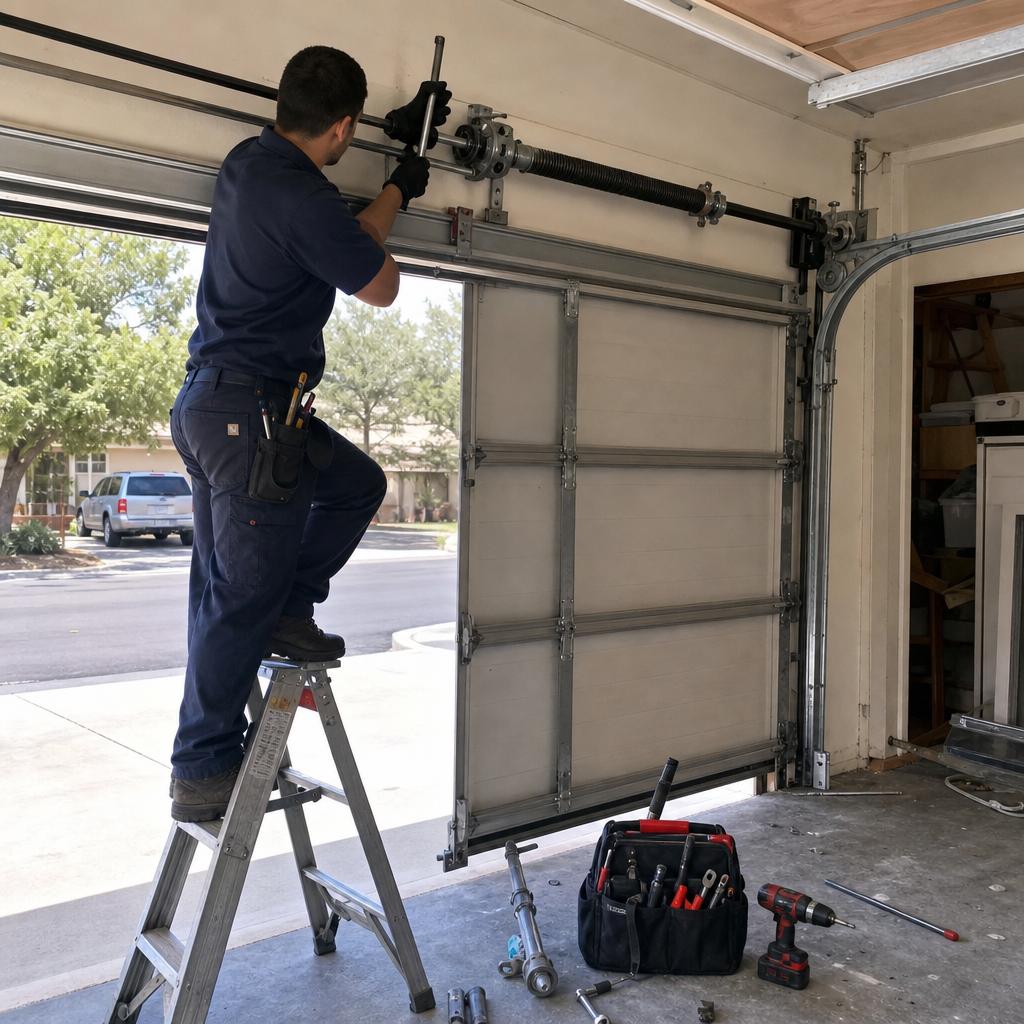
After inspecting thousands of garage doors across the valley, the single most common cause of premature failure isn’t age — it’s a 90-second lubrication job that never got done because homeowners were using the wrong product on the wrong parts. A shot of WD-40 on dry springs feels productive. In Las Vegas heat, it’s quietly accelerating the failure you’re trying to prevent. This guide exists because the national maintenance checklists were written for climates that never hit 115°F, never dry out weatherstripping in a single summer, and never run torsion springs through the kind of thermal cycling our valley dishes out from May through September.
Quick Answer
A complete garage door maintenance checklist for Las Vegas homeowners breaks into four seasonal windows: pre-summer (April), pre-monsoon (June), post-summer cooldown (October), and a light mid-winter check (January). The tasks that matter most in Las Vegas — UV seal inspection, torsion spring lubrication with silicone-based product, and opener force recalibration — are almost never covered in generic national guides. Do these right, twice a year, and you’ll extend the life of springs, rollers, and weatherstripping by several years.
Table of Contents
- Monthly Tasks: 5-Minute Checks That Prevent Expensive Repairs
- Pre-Summer Checklist (April): Getting Ready for the Heat
- Pre-Monsoon Checklist (June): Before the Storms Roll In
- Post-Summer Cooldown Checklist (October): Assessing the Damage
- The Right Way to Lubricate a Garage Door in Las Vegas
- How to Check Spring Tension After Heat Exposure
- How to Inspect Your Bottom Seal and Weatherstrip for UV Damage
- Opener Force Settings: Why Las Vegas Homeowners Should Retest Every Fall
- Common Mistakes to Avoid
- When to Call a Professional
- Frequently Asked Questions
- The Bottom Line
Monthly Tasks: 5-Minute Checks That Prevent Expensive Repairs
Most garage door problems don’t appear overnight. They build over weeks through small mechanical changes — a roller that’s getting noisy, a track that’s accumulating debris, a photo-eye that’s drifting slightly out of alignment. Catching these early in Las Vegas is especially important because the heat accelerates wear. A roller that’s 30% worn in a moderate climate might last another year. Here, it might fail by August.
Run through these checks once a month. They take less time than a coffee run.
- Listen to the door as it opens and closes. Grinding or scraping usually points to worn rollers or misaligned tracks. Popping sounds often indicate a lubrication issue on the springs or hinges.
- Watch the door move. It should travel in a straight, smooth arc. Jerking or hesitation on one side suggests a spring tension imbalance or a roller beginning to bind in the track.
- Test the auto-reverse. Place a 2×4 flat on the floor under the door and trigger the close cycle. The door must reverse on contact. If it doesn’t, stop using the opener until it’s adjusted.
- Clear the tracks of debris. Las Vegas dust and desert grit accumulate in the bottom of the vertical track section. Wipe it out with a dry rag — do not lubricate the tracks themselves.
- Check the photo-eye alignment. Both sensors should have steady indicator lights. A blinking or off light means the beam is broken or misaligned. Wipe lenses clean; desert dust coats them faster than most homeowners expect.
Pre-Summer Checklist (April): Getting Ready for the Heat
April is the most important maintenance window for Las Vegas garage doors. By May, temperatures are already pushing into the 90s, and by July the attic space above a garage can exceed 140°F — enough to cook lubricant off metal surfaces, degrade rubber seals, and put mechanical stress on springs that have already been cycling daily for months. What you do in April determines how the door performs through the worst of summer.
- Lubricate springs, hinges, and rollers with a silicone-based or lithium-based grease before temperatures climb (more on product selection in the lubrication section below).
- Inspect the bottom seal for cracking, brittleness, or sections that have pulled away from the door panel. UV degradation shows up as pale gray discoloration and surface cracking on rubber seals — replace before summer if you see either.
- Check all weatherstripping along the sides and top of the door frame. Press it firmly against the door. If it springs back and seals completely, it’s fine. If it stays compressed or shows visible cracking, it won’t survive another summer.
- Inspect door panels for warping, especially on steel doors with foam cores. Sun exposure on west-facing doors in communities like Summerlin South, Henderson, and the southwest valley can cause panel faces to expand unevenly over several summers.
- Test spring balance using the manual disconnect (the red cord). Pull it, lift the door by hand to waist height, and let go. It should stay put — or drift no more than a few inches. If it drops or rockets upward, tension is off.
- Tighten all hardware. Every bolt on the track brackets, every hinge screw. Las Vegas homes run their garage doors heavily — two cars, sometimes three, multiple cycles daily. Hardware vibrates loose over winter.
Pre-Monsoon Checklist (June): Before the Storms Roll In
Las Vegas gets an average of 4 inches of rain per year, but a good chunk of that arrives in the July–September monsoon window as fast, intense storms. A garage door that’s been baking in dry heat all spring suddenly needs to handle blowing rain, airborne debris, and pressure differentials from gusty wind. The failure points are different from what summer heat targets — they’re the sealing surfaces and the structural connection between panels and hardware.
- Re-inspect the bottom seal. If you replaced it in April, confirm it’s still seated evenly. If you deferred the replacement, do it now — a gap at the bottom lets water pool on the garage floor during a hard monsoon storm and invites desert critters looking for shelter.
- Check the top and side weatherstrip for separation from the frame. Adhesive-backed weatherstripping on older doors often loses bond strength after spring heat exposure.
- Test the manual disconnect. In a power outage during a storm, you need to know the door will open manually without a fight. Operate it by hand and confirm it moves freely.
- Clear the area around the photo-eyes. Monsoon winds carry a surprising amount of debris. Anything that blocks or nudges the sensor alignment during a storm will leave your door stuck open or refusing to close.
- Inspect cable drums and cables. Look for fraying, uneven winding, or any cable that’s jumped off its drum. These are visual checks only — don’t touch cables under tension.
Post-Summer Cooldown Checklist (October): Assessing the Damage
October is Las Vegas homeowners’ chance to see what four months of extreme heat actually did to the door system. Temperatures drop out of triple digits, and parts that have been expanding and contracting daily start to settle into their cooler-weather dimensions. This is when stress fractures become visible, when worn rollers make themselves known, and when opener force settings — calibrated in spring — often need adjustment.
- Full visual inspection of springs. Look for gaps in the coils of torsion springs (a gap means a partial or imminent break), rust spots, or discoloration from heat stress. A torsion spring on a two-car door in Las Vegas that’s been through five or more summers without service is due for proactive replacement.
- Roller inspection. Steel rollers with nylon wheels show cracking on the wheel face after heat exposure. Spin each roller by hand — it should spin freely and quietly. Any roughness or wobble means the bearing is going.
- Retest opener force settings — covered in depth in the opener section below, but do it every October without exception.
- Lubricate again. Whatever you applied in April has largely burned off. A full lubrication pass in October prepares the door for the cooler months and protects metal parts from the relatively mild but real Las Vegas winter humidity.
- Inspect panel joints and hinges for any stress cracking introduced by summer thermal expansion. On multi-panel doors, the hinge connection points take significant strain when panels flex in the heat.
- Check the opener’s battery backup if your unit has one. LiftMaster and Chamberlain models with battery backup systems use batteries that degrade faster in heat — replace every two years at minimum if the opener is in an unconditioned garage.
The Right Way to Lubricate a Garage Door in Las Vegas
This is where most Las Vegas homeowners go wrong, and it’s worth explaining exactly why. WD-40 is a penetrating solvent and water displacer — it’s excellent for breaking rust and loosening stuck fasteners. It is not a lubricant for garage door springs. In a moderate climate, applying WD-40 to springs causes gradual degradation. In Las Vegas heat, the solvent evaporates almost immediately, leaving behind a residue that actually attracts grit and accelerates metal-on-metal wear. We’ve pulled springs off doors that looked like they were coated in sandpaper from WD-40 application in this climate.
What to use instead:
- Torsion and extension springs: Use a white lithium grease spray or a dedicated garage door lubricant (3-IN-ONE Garage Door Lube and Clopay’s branded lubricant are both formulated to hold up in temperature extremes). Apply directly to the coils while the door is closed, then cycle the door several times to work it in.
- Hinges and roller stems: Same lithium-based spray. Focus on the pivot point of each hinge and the stem of each roller where it enters the hinge bracket. Do not spray the roller wheel itself — that’s where it contacts the track.
- Tracks: Do not lubricate. Tracks should be clean and dry. Lubricant on tracks causes rollers to skip and doors to drift off-center.
- Opener chain or belt: Chain drives get a light application of white lithium grease on the chain only. Belt drives are maintenance-free — don’t apply anything. Screw drives get a very light application of the manufacturer-specified grease on the drive screw.
- Lock and lock bar: A spray of dry Teflon lubricant keeps lock mechanisms from seizing in the summer heat.
In Las Vegas, lubricate twice a year: once in April before temperatures peak, and once in October after they drop. The heat burns off product faster than in most regions — annual lubrication simply isn’t enough here.
How to Check Spring Tension After Heat Exposure
Torsion springs operate under significant stored tension, and that tension changes with temperature. Over a Las Vegas summer — with attic spaces regularly exceeding 120°F and overnight lows still in the 80s — springs that cycle through months of extreme heat can lose a small but measurable amount of tension. The result is a door that feels heavier than it should, which puts extra strain on the opener motor and cables. Checking balance in October tells you where the springs actually are after the season.
The manual balance test — step by step:
- Close the garage door fully.
- Pull the red emergency disconnect cord to disengage the opener.
- Lift the door by hand to approximately waist height (about 3–4 feet off the floor).
- Let go completely and step back.
- Watch for 10–15 seconds.
What the result means:
- Door stays put (moves less than 2 inches): Springs are properly balanced. No adjustment needed.
- Door drifts down slowly: Springs are slightly under-tensioned. The opener is compensating, but spring adjustment is recommended.
- Door drops quickly: Springs are significantly under-tensioned. Have them adjusted before continuing to use the opener — the motor is carrying load it shouldn’t be.
- Door rises on its own: Springs are over-tensioned. This is less common but can happen if springs were adjusted without accounting for Las Vegas heat expansion. Reduce tension.
Spring adjustment requires winding or unwinding the torsion bar — a task that involves working directly with a component under significant stored energy. We don’t recommend homeowners attempt this without hands-on training. If the balance test shows a problem, it’s a straightforward professional fix.
How to Inspect Your Bottom Seal and Weatherstrip for UV Damage
Las Vegas averages over 300 sunny days per year. A south- or west-facing garage door takes direct sun exposure for hours every day, and rubber seals absorb UV radiation that gradually breaks down their polymer structure. What looks like a minor cosmetic issue — a little cracking, a slight color change — is actually the rubber losing its elasticity and ability to compress and seal.
Signs the bottom seal needs replacement now (not next season):
- Surface cracking visible without bending the seal — cracks wider than a hairline mean the rubber has already become brittle.
- Color has shifted from black to gray or tan — UV bleaching is a reliable indicator of polymer degradation.
- The seal no longer contacts the floor evenly when the door is closed — you can see light gaps from inside the garage.
- Sections of the seal have separated from the door’s retainer channel and are hanging loose.
- The seal feels hard and unyielding rather than pliable — squeeze it between your fingers. It should compress easily. If it doesn’t flex, it won’t seal.
Signs you can wait until next season:
- Minor surface crazing (fine surface lines only, no deep cracks) with no gaps in contact against the floor.
- Seal is still fully pliable and returns to shape after compression.
- No light visible under the door from inside the garage.
For side and top weatherstripping, run your hand along the full perimeter of the door while it’s closed. You’re feeling for cold air in winter or any gap where the strip has compressed flat or pulled away from the stop molding. In neighborhoods like North Las Vegas and Henderson, we see UV-degraded perimeter weatherstrip fail faster on doors with dark-colored frames that absorb more heat — something to factor into your inspection timing.
Opener Force Settings: Why Las Vegas Homeowners Should Retest Every Fall
Every garage door opener — whether it’s a LiftMaster, Genie, Chamberlain, or Craftsman unit — has adjustable force settings that determine how much resistance triggers a reversal or stop. These settings exist for safety: if the door meets an obstacle while closing, it needs to reverse before it causes injury or damage.
Here’s the problem specific to Las Vegas: metal parts contract as temperatures drop from summer to fall. A door that moved smoothly at a given force setting in July — when rollers, hinges, and springs were all at operating temperature — may move more stiffly in November. If the opener’s force setting hasn’t been increased slightly to compensate, it may interpret normal cool-weather friction as an obstacle and reverse mid-cycle. Conversely, if force is set too high, the auto-reverse safety feature is compromised.
How to retest opener force settings in October:
- Locate the force adjustment dials or buttons on your opener unit — typically labeled “Up Force” and “Down Force.” Consult your model’s manual for exact location; LiftMaster and Chamberlain units usually have them on the back or side of the motor housing.
- Operate the door through three full open/close cycles and watch for hesitation, reversal without obstruction, or straining sounds from the motor.
- Perform the resistance test: while the door is closing, place your hands flat on the bottom panel and apply moderate upward resistance. The door should reverse immediately. If it doesn’t, the down-force setting is too high — reduce it.
- Test the auto-reverse with a 2×4 on the floor (as described in the monthly tasks section) to confirm the physical reversal is working.
- If the door reverses on its own without obstruction, increase the down-force setting by one increment and retest.
Wayne Dalton and Raynor openers use similar adjustment systems, though the control interface varies by model. If you’ve lost the manual, the manufacturer’s website has model-specific PDFs — or call us and we can walk you through it for the brand you have.
Common Mistakes to Avoid
- Using WD-40 on springs or hinges. In Las Vegas heat, it evaporates and leaves behind a grit-attracting residue. Switch to a lithium-based garage door lubricant — your springs will last noticeably longer.
- Skipping the April maintenance window. Pre-summer prep is the single most important maintenance task in this climate. Homeowners who skip it and plan to catch it in July are servicing a door that’s already been stressed by triple-digit heat.
- Lubricating the tracks. Tracks should be clean and dry. Applying grease or oil to the track causes rollers to slip, doors to drift, and debris to accumulate faster — all of which lead to repairs.
- Manually forcing a door that’s binding. If the door feels heavy or stiff, forcing it by hand risks a sudden spring failure. Do the balance test first to diagnose the cause before applying force.
- Ignoring a fraying cable. Cables under tension don’t give much warning before they fail. If you see any fraying during a visual inspection, stop using the door and call a technician. In South Las Vegas neighborhoods where dust and monsoon moisture combine to accelerate cable wear, this is worth checking twice a year.
- Replacing only one spring when the other fails. Torsion springs on a two-car door are typically installed as a matched pair and age at the same rate. If one breaks, the other is near the end of its service life too. Replace both at the same time — it saves a second service call within months.
- Assuming a new door needs no maintenance. We see this regularly with newly built homes in Summerlin South and the southwest valley — brand-new Clopay and Amarr doors that have never been lubricated from the day they were installed. Factory lubricant burns off quickly in desert heat. New doors need their first service within six months of installation.
When to Call a Professional
Some garage door maintenance is genuinely safe for homeowners to handle: lubrication, basic visual inspection, hardware tightening, photo-eye alignment, and the manual balance test. But several tasks cross into territory where DIY attempts cause more damage — or serious injury — than the original problem.
Call a professional when you see:
- A broken torsion spring (visible gap in the coil, or the door is suddenly very heavy)
- A frayed or snapped cable
- A door that’s off its tracks
- The balance test showing the door drops or rises significantly
- Any damage to the bottom section that affects how the door seals or how the cable attaches
- An opener that reverses on its own, won’t fully close, or shows error codes
If you’re in Las Vegas and the door won’t open or close safely, Express Garage Door Repair offers free estimates and same-day emergency service. Call Edward Young and the team directly at (725) 237-5587.
Frequently Asked Questions
How often should I lubricate my garage door in Las Vegas?
Twice a year — once in April before peak heat, and once in October after temperatures drop. Las Vegas heat burns off lubricant faster than in most climates, so the standard national recommendation of once per year isn’t enough here. Use a white lithium grease spray or a dedicated garage door lubricant, never WD-40. Call (725) 237-5587 if you want a professional lubrication and tune-up done right.
What’s the most common garage door repair in Las Vegas?
Broken torsion springs are the most common repair we see across Las Vegas — particularly in late summer and fall, when springs that have been through months of extreme thermal cycling reach the end of their service life. The second most common issue is UV-degraded bottom seals and weatherstripping, which fail faster here than in nearly any other U.S. climate.
Can I do my own garage door maintenance, or do I need a technician?
Homeowners can safely handle lubrication, visual inspections, hardware tightening, photo-eye cleaning, and the manual balance test. Spring adjustment, cable replacement, and any work involving components under tension should be handled by a trained technician. The risk of injury from improper spring work is real — it’s not a task worth attempting without the right tools and experience.
How do I know if my garage door spring is about to break?
The clearest warning signs are: the door feels noticeably heavier when lifted manually, the door drifts downward when released at waist height during the balance test, you see a visible gap in the torsion spring coil, or you hear a loud bang from the garage (the sound of a spring snapping). In Las Vegas, springs that are five or more years old and haven’t been serviced are worth having professionally inspected — especially heading into summer.
What type of garage door holds up best in Las Vegas heat?
Steel doors with a polyurethane foam core (like several Clopay and Amarr models) handle Las Vegas heat better than hollow steel or wood-composite options. The foam core acts as insulation and reduces the rate of thermal expansion and contraction that stresses hinges and panel joints over time. For west-facing garages in particular, a door with a higher R-value also meaningfully reduces interior garage temperatures.
Does a new garage door installation in Las Vegas require a permit?
In most cases, a straight replacement of an existing residential garage door with a unit of the same size does not require a permit in Clark County. However, if the opening is being modified, or if structural work is involved, a permit is typically required through Clark County Building Department. When in doubt, check with your contractor before work begins — any reputable company should pull the appropriate permits without being asked. For Garage Door Installation in Summerlin South and surrounding areas, we handle the permit question upfront so there are no surprises.
The Bottom Line
A garage door in Las Vegas faces conditions that simply don’t exist in the generic maintenance guides — extreme UV exposure, sustained triple-digit heat, monsoon moisture, and a thermal cycle that wears springs and seals faster than most climates. The homeowners who avoid expensive repairs are the ones who work on an April-June-October schedule, use the right lubricant on the right parts, and do the balance test twice a year. Catch a worn seal before summer, catch a spring going soft before it breaks, and you’ll go years between service calls. Let those tasks slide, and Las Vegas will find the weak point first.
12 years and 1,222 verified reviews later, the problems Edward Young sees most often are entirely preventable — which is exactly why this checklist exists. For Garage Door Opener service in Summerlin South or anywhere across Las Vegas, the call is the same: (725) 237-5587.
Ready for a Free Estimate?
If your maintenance check turned up something you’re not sure about — a spring that doesn’t feel right, a seal that’s borderline, an opener that’s been fighting the door since summer — don’t leave it until it fails on a 110°F Tuesday morning. Edward Young at Express Garage Door Repair serves Las Vegas homeowners directly, diagnoses on-site, and fixes the same visit whenever parts allow. Call (725) 237-5587 for a free estimate. No runaround, no subcontracted crews — the same person who answers knows the work.
For homeowners in the northwest part of the valley, our Garage Door Repair in Summerlin South page covers the specific issues we see most often in that area.
Written by Edward Young, Owner & Lead Technician at Express Garage Door Repair, serving Las Vegas since 2014.